
Insights
Before We Decide What Happened
Most public conflicts now seem to follow the same pattern. An incident occurs, fragments of information emerge almost immediately, and before long people have divided into opposing camps, each convinced they already know what happened and who was to blame. The speed with which certainty arrives often seems inversely proportional to the amount of reliable information available. As a mediator, I’ve learnt to be suspicious of that certainty. My first instinct is rarely to ask who is right. It’s to ask what question nobody else seems to be asking.
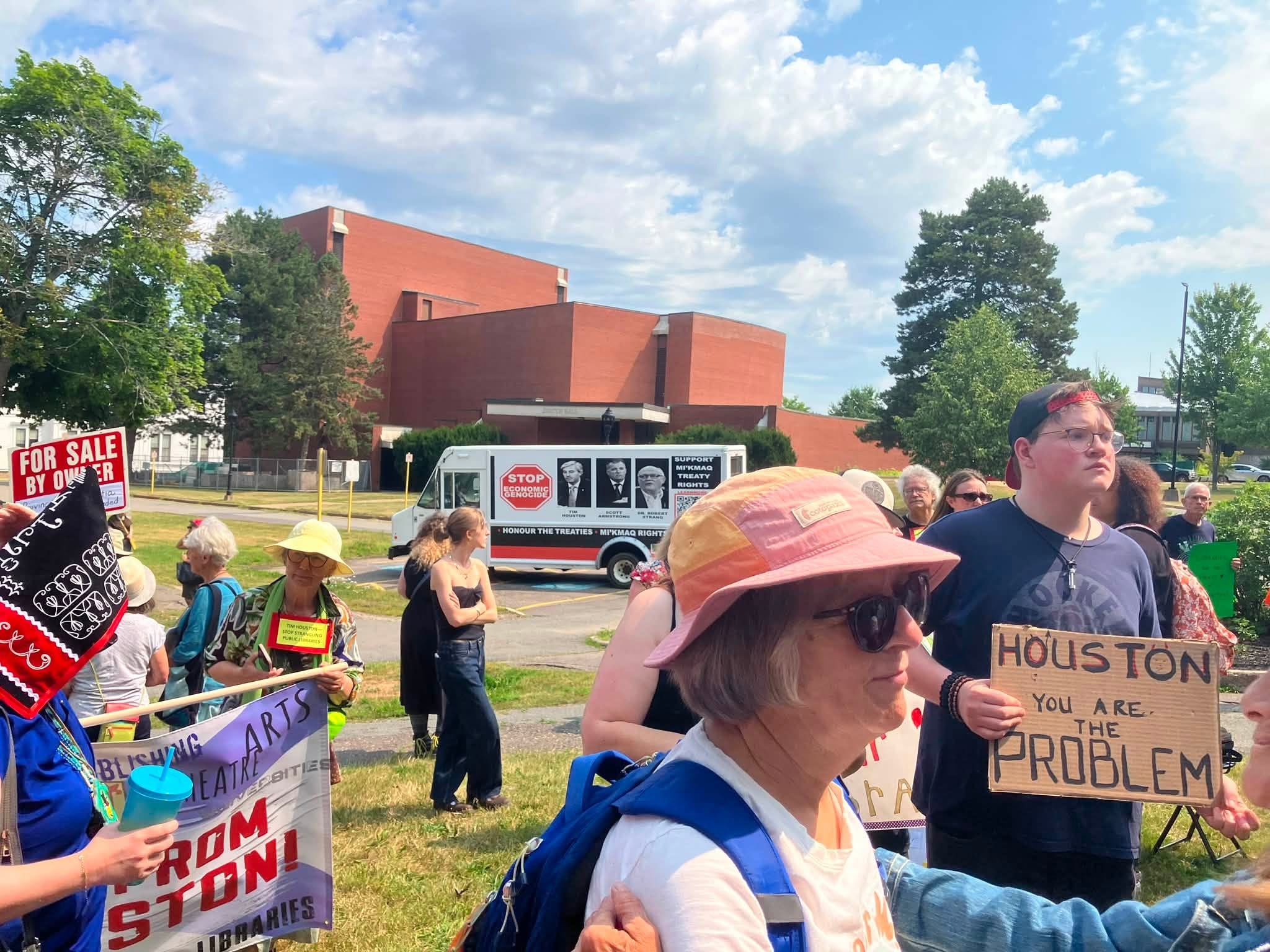
Photo credit: Fred Rhynold
The confrontation involving Premier Tim Houston at Acadia University this past week has occupied a great deal of public attention. So has the commentary: most of it entrenched in “knowing”. Whether I’m brought in as a mediator, facilitator or organisational consultant, I’ve learnt that the presenting conflict is almost never the actual problem. The visible dispute is usually the point at which deeper conditions have finally become impossible to ignore. I asked a different question. Not “who broke the windshield”, but
“What actually brought that many people, with that many different grievances, to the same parking lot on the same day, at the same time?”
That question on Facebook resulted in a mix of responses. Some signalled agreement that we need to know the answer to that question, some offered more detail, e.g. video clips taken by people with their phones in hand, at the time of the incident, and an extract from a policy on SOP (Standard Operating Procedures) for security staff responsible for the safety of Canadian politicians. And some suggested that I was blaming the victim, defending the protesters, or attacking the Premier and/or his driver.
Asking where a conflict came from gets treated as a verdict on where it should land. The space between understanding and agreement seemed to have gone missing.
That narrowing concerns me more than any single incident does. What I was attempting to do in asking the question was to understand the context:
We cannot know what would address the problem until we understand what the problem actually is.
A reasonable question normally signals curiosity, interest, concern, and a commitment not to make assumptions, regardless of the incident that attracts the attention, not support of the windshield breakers nor of the beleaguered politician.
In mediation we know that the presenting conflict is almost never the actual problem.
The parties don’t necessarily know or feel that, so it’s up to the mediator to ask the right questions from a lens of curiosity, not assumption and judgment. If you respond only to what’s in front of you - the shouting, the broken windshield, the headline - you end up solving the wrong problem or not solving anything at all. Conflict is the point where an underlying strain finally became visible: it isn’t the point of origin.
So instead of beginning with the obvious question - what happened? - I find myself asking three others. Is this conflict emerging from a relationship in which trust has already been eroded? Is there a growing gap between what people were told would happen and what they believe is actually happening? And are there functioning structures through which concerns can realistically be raised, heard and addressed? I think of these as trust, integrity and structure: three operating conditions that shape the health of any relationship, whether between two people, within a team, or between citizens and their government.
None of these are about character. Low trust doesn’t mean someone is a liar. Weak structure doesn’t mean someone is incompetent. They’re operating conditions, and by the time a conflict becomes visible, all three are usually already strained. Behaviour is what shows up last. It’s the outcome, not the cause.
Over the years I’ve found myself returning to these three questions often enough that they eventually became a framework I now use in my work. Not because they produce quick answers, but because they remind me to slow down long enough not to mistake my own interpretation for reality. They keep me curious about another person’s experience even when I disagree with it.
Although I developed this way of thinking through my work with organisations, teams and families, I have come to believe the same questions apply whenever groups of people find themselves in conflict. Governments are simply organisations operating at a different scale. Citizens, like employees or community members, form expectations about whether they can trust what they are told, whether actions remain aligned with stated commitments, and whether there are credible ways of raising concerns before frustration spills into public confrontation.
If there is perceived malignment between what was promised and what is happening on the ground, isn’t that breach of trust?
Reading Acadia through it, not around it
I wasn’t there, and I’m not going to pretend the windshield being smashed is anything other than what it looks like: an act that put a person at real physical risk and handed every critic a reason to stop listening to everyone in that crowd. I’m not interested in relitigating that.
I’m interested in the question almost nobody is asking about the crowd itself.
People didn’t gather there over one thing. I came to understand that the issues that brought demonstrators to Wolfville on July 15 included indigenous treaty rights, resource development, old-growth logging, and funding cuts affecting among others, local libraries and museums. This is a convergence of issues anchored in the choices being made by the provincial government, being protested all in the same space, on the same afternoon. That’s not one grievance escalating: that’s several unconnected constituencies converging on the same public stage, at once. Through my lens, that convergence is itself information. It suggests people across several unrelated areas of social engagement and relationship with government have independently concluded that the ordinary channels aren’t reliable, aren’t aligned with what they were told, or are not accessible to them at all.
I don’t know which of those grievances brought any given person to participate in that demonstration that day, but there they were. Seems hundreds of them. Probably it was some blend; different for each grievance. The “riot” and the “suppression of right to peaceful protest” framing both skipped over the true causality and landed sharp judgments faster.
The question I’d actually want answered
Not who was right. Not who was wrong.
Before anyone decides what last Wednesday meant, I’d want to know: on each of those five issues, was there a channel that felt real to the people who showed up on this day to articulate their grievance? A person, a process, a place where being heard didn’t require standing in a parking lot? And if so, did they make use of such a channel? And what was their experience if they did?
What is the missing piece? Is it trust, alignment, or structure,
because the fix is different depending on which one it is.
I don’t have that answer. I’m not sure the people arguing most loudly about this one have it either. But I’d rather sit with the question than reach for a conclusion that lets me stop looking.
Nor is this uniquely a Nova Scotia question. Every week we’re presented with images and narratives of conflict somewhere in the world, accompanied by confident explanations of what happened and who was responsible. I find myself wondering how often who, if anyone, asks the questions that come before those conclusions. Which version do I trust?
Much of my work begins when organisations believe they have a conflict problem. More often than not, the conflict turns out to be evidence of something else: a breakdown in trust, a gap between stated intentions and lived experience, or structures that no longer allow people to raise concerns before relationships deteriorate. That’s the work that interests me most. That’s the work that interests me most. If these are questions your own organisation is wrestling with, you’ll find more about my approach here.
Thanks for reading Delphine's Substack! Subscribe for free to receive new posts and support my work.